

Small Business Bookkeeping Services Built for Florida Filings
Our small business bookkeeping services keep your books reconciled, categorized, and closed every month, so the numbers behind every tax return and state filing are ready before the deadline. For a Florida business, that means one set of books that feeds the sales tax return, the reemployment tax report, the tangible personal property return, and your federal filings, without a scramble in April.
Florida is home to 3.5 million small businesses, according to the U.S. Small Business Administration’s Office of Advocacy, and most of them are run by owners who didn’t start a company to reconcile bank statements. We take that work off your plate, in English, Spanish, or Portuguese, starting at $250 per month.
Small business bookkeeping services record, reconcile, and report every transaction in your business each month: bank and credit card reconciliations, expense categorization, accounts payable and receivable, and monthly financial statements. In Florida, clean books also produce the reports behind your state sales tax, reemployment tax, and tangible property filings.
What Our Small Business Bookkeeping Services Include
Every deliverable, what it means, and what you get at the end of each month.
A bookkeeping service is only as useful as what lands in your inbox. Here is exactly what our bookkeeping services for small business owners cover, with the output you receive for each one.
| Service | What we do | What you receive |
|---|---|---|
| Bank and credit card reconciliation | Match every transaction in your software to your statements and resolve differences | Balances you can trust, month after month |
| Transaction categorization | Code income and expenses to the right accounts, including owner draws and loans | A clean chart of accounts your tax preparer can use |
| Accounts payable and receivable | Track unpaid bills and open invoices | An aging list so nothing slips past due |
| Monthly financial statements | Close the month and prepare the profit and loss statement and balance sheet | Two reports that show profit, not just cash |
| Payroll processing | Run payroll and keep wage records organized | Payroll records that match your books and your filings |
| Sales tax records | Separate taxable and exempt sales and track tax collected in your books | The figures your Florida sales tax return is built from |
| Cash flow reporting | Show where cash came from and where it went each month (Growth plan and up) | An early warning before a tight month |
| 1099 preparation | Track contractor payments and prepare Forms 1099 (Pro plan and up) | Contractor forms ready before the January 31 deadline |
| Tax preparation support | Hand year-end books and a document package to your CPA | Fewer questions and less back-and-forth at tax time |
| Catch-up bookkeeping | Rebuild months or years of missing records | Current books before you start monthly service |
If you only need the recurring work, see our monthly bookkeeping service. If your accountant prepares the return, our tax preparation support makes sure the books they receive are already reconciled.
Bookkeeping is not tax advice. We prepare the records and reports; decisions about deductions, entity type, or how to file belong to a CPA or tax professional who knows your full situation.
Tell us how many accounts you have and how far behind you are. We reply with a clear monthly price.
Signs You Need Professional Bookkeeping Services
If two or more of these sound familiar, your books are costing you more than a bookkeeper would.
Your bank balance is the only number you check, and you are not sure how much of it is actually profit.
You haven’t reconciled your accounts in more than a month, or you never have.
Personal and business expenses run through the same card or account.
You collect Florida sales tax but piece together the return from invoices on the due date.
You hired your first employee and aren’t sure what records payroll requires.
Your CPA sends a list of questions every spring, and answering them takes days.
You paid a contractor during the year and don’t know whether you owe them a Form 1099-NEC.
These are the bookkeeping problems we fix most often. Each one has a cost: a late sales tax return in Florida carries a penalty of 10% of the tax due, with a $50 minimum, according to the Florida Department of Revenue, even when the tax itself was small.
Florida Filing Map: Tax and Bookkeeping Services Built Around Your Deadlines
Which report from your books feeds which Florida and federal filing, and when.
Florida has no personal state income tax, so many owners assume the state asks for little. In practice, a Florida small business can face several state filings a year on top of its federal return, and every one of them is built from your bookkeeping. The map below shows the link.
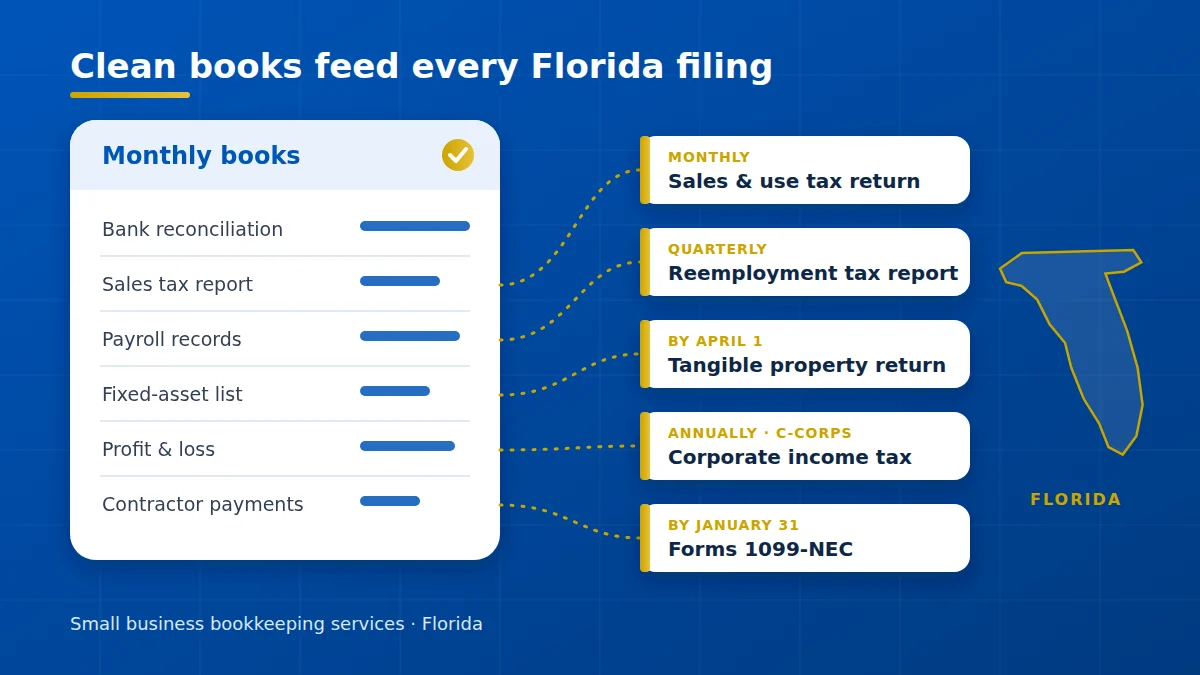
| Filing | Who files | When | What your books must produce |
|---|---|---|---|
| Sales and use tax return (DR-15) | Businesses that sell taxable goods or services | Due on the 1st and late after the 20th of the month after each reporting period | Taxable and exempt sales, tax collected, and the county surtax by location |
| Reemployment tax report (RT-6) | Employers, even in a quarter with no wages paid | Quarterly: April 30, July 31, October 31, and January 31 | Wages per employee; only the first $7,000 per employee per year is taxable. A late report costs $25 for each 30 days |
| Tangible personal property return (county property appraiser) | Businesses that own equipment, furniture, or other business property on January 1 | By April 1 | A fixed-asset list with costs and purchase dates |
| Corporate income tax (F-1120) | C corporations and LLCs taxed as corporations | Annually | Net income; the first $50,000 of Florida net income is exempt, and the rate is 5.5% of the taxable amount |
| Annual Report (Sunbiz) | Corporations, LLCs, and limited partnerships | By May 1 | Current entity information; a $400 late fee applies to for-profit corporations, LLCs, and limited partnerships (nonprofit corporations are exempt) |
| Form 1099-NEC (IRS) | Businesses that pay contractors | By January 31, to the IRS and the contractor | Contractor payments; the threshold is $2,000 for payments made after December 31, 2025 |
| Federal estimated tax (IRS) | Sole proprietors, partners, and S corporation shareholders who expect to owe $1,000 or more; corporations that expect to owe $500 or more | Four payment periods a year | A year-to-date profit and loss statement |
You must file a sales tax return for every reporting period, even if no tax is due. File and pay electronically on time and Florida lets you keep a collection allowance of 2.5% of the first $1,200 due, up to $30 per return (Florida Department of Revenue, DR-15N instructions).
Two details surprise new owners. First, the reemployment tax rate for a new employer is 2.7% until you have reported for 10 quarters, after which the Department calculates your own rate; for 2026 the range runs from 0.1% to 5.4% (Florida Department of Revenue). Second, if your tangible personal property return is filed by April 1, the business is eligible for an exemption of up to $25,000 of assessed value. Miss the date and you lose that eligibility, which is why we keep a running fixed-asset list.
Sales tax is also local: Florida’s general rate is 6%, plus a discretionary surtax that most counties add. If you operate in Duval County, our page on bookkeeping for Jacksonville businesses covers the local rate. And if your entity stops filing, Sunbiz administratively dissolves or revokes it on the fourth Friday of September when the Annual Report is still missing after the third Friday.
How Our Outsourced, Virtual Bookkeeping Services Work
Remote from start to finish, with one person who knows your books.
Our virtual bookkeeping services run entirely online, so it doesn’t matter whether you are in Miami, Orlando, or a town without a local bookkeeper. You work with one dedicated bookkeeper who learns your accounts, your vendors, and your filing calendar. Here is how it works, from getting started to your monthly reports.
Free consultation
We talk through your business, how many bank and card accounts you have, whether you run payroll, and whether you collect Florida sales tax. You leave the call with a clear scope.
Secure access
You give us access through your accounting software’s own user permissions. We work in QuickBooks Online, Xero, or FreshBooks, and you can remove our access at any time.
Cleanup, if needed
If the books are behind, we bring them current first. Our guide on how a clean-up works in Florida explains what that involves.
Monthly close
Every month we reconcile, categorize, and close the books, then prepare your profit and loss statement and balance sheet.
Reports and review
You receive your reports with a short summary of what changed, and you can ask questions in English, Spanish, or Portuguese.
Want to know who handles your books? Read who handles your books and why.
Outsourced Bookkeeping Services vs. an In-House Bookkeeper
What each option costs and covers, using U.S. government wage data.
The U.S. Bureau of Labor Statistics reports a median wage of $50,670 a year ($24.36 an hour) for bookkeeping, accounting, and auditing clerks as of May 2025 (BLS Occupational Outlook Handbook). That is roughly $4,223 a month in wages alone, before payroll taxes and benefits.
| Factor | In-house bookkeeper | Outsourced bookkeeping services |
|---|---|---|
| Monthly cost | About $4,223 in median wages, plus payroll taxes and benefits | Starting at $250 per month |
| Florida payroll obligations | Adds an employee: reemployment tax on the first $7,000 of wages, quarterly reports | None; we are a vendor, not an employee |
| Software | You pay for licenses and set-up | Works in the software you already use |
| Coverage | Stops during vacations or turnover | Monthly close continues regardless |
| Best fit | High transaction volume that needs someone on site daily | Most small businesses with a few accounts and monthly reporting needs |
Outsourcing is not always the answer. If your business processes hundreds of transactions a day or needs someone to handle deposits in person, an employee may make sense. For most Florida small businesses, outsourced bookkeeping services cost a fraction of a salary and deliver the same monthly reports.
Monthly, Catch-Up, or Full-Service: Which Level Do You Need?
Match the service to where your books are today.
Not every business needs the same thing on day one. Most of our clients start in one of three places, and the right starting point depends on how current your books are, not on the size of your company.
Monthly bookkeeping
Your books are current and you want them to stay that way. We reconcile, categorize, and close each month and send your profit and loss statement and balance sheet.
Catch-up bookkeeping
You are months or years behind, or your last bookkeeper left a mess. We rebuild the missing periods first, so your monthly service starts from accurate balances.
Full-service financial management
Bookkeeping plus payroll, accounts payable and receivable, and the reports your CPA needs at year end, all kept in one set of books.
If you are unsure, start with the free consultation. We look at your last reconciled month, your open sales tax periods, and whether you have employees, and recommend the lightest level that keeps you compliant. You can move up or down as the business changes.
What Affordable Bookkeeping and Payroll Services Cost
Our starting price, and the six factors that move it.
Monthly bookkeeping with us starts at $250 per month. There are four plans, each with a price range; where you land inside the range depends on how much work your books actually need, which we confirm in a free consultation.
| Plan | Monthly price | What it adds |
|---|---|---|
| Starter: Financial Organization | $250 to $350 | Organized transactions, monthly reconciliations, profit and loss statement and balance sheet, ongoing support |
| Growth: Financial Clarity and Control | $450 to $650 | Everything in Starter, plus accounts payable and receivable tracking, invoice and payment management, cash flow reporting, and basic job costing |
| Pro: Financial Management | $850 to $1,200+ | Everything in Growth, plus advanced job costing, project-level profitability, 1099 preparation, custom reports, strategy meetings, and QuickBooks optimization |
| Premium: CFO-Level Support | $1,500 to $3,000+ | Everything in Pro, plus weekly oversight, cash flow planning and projections, growth strategy, and loan or funding preparation |
Within each plan, these factors decide the final number:
| Factor | Why it changes the price |
|---|---|
| Monthly transaction volume | More transactions mean more to categorize and reconcile |
| Number of bank and card accounts | Each account is reconciled separately every month |
| Payroll | Adds wage records, payroll reconciliation, and quarterly reemployment tax data |
| Florida sales tax records | Requires separating taxable and exempt sales, and county surtax by location |
| Months behind | Catch-up work is priced separately before monthly service starts |
| Job costing | Adds profit tracking by job or project |
Have your last three months of bank and credit card statements, your payroll provider (if any), and your sales tax account status ready for the consultation. That’s usually enough for a firm monthly price.
Who Our Bookkeeping Services for Small Business Owners Serve
Four kinds of Florida businesses and what their books need most.
Startups and new LLCs
Set up the chart of accounts correctly from day one, separate owner money from business money, and track the $2,000 threshold for contractor 1099s.
Contractors and service businesses
Job costing, customer invoices, and equipment purchases that feed the tangible personal property return every April.
Retail and e-commerce
Taxable versus exempt sales and tax collected by location, ready for each Florida sales tax return.
Businesses with employees
Payroll records that match the books, plus the wage data behind quarterly reemployment tax reports.
Not sure which applies to you? In our experience, most owners fit two of these at once, which is exactly why one set of books has to serve every filing.
Book a free consultation and get a monthly price based on your actual accounts and filings.
Tax and Bookkeeping Questions Florida Owners Ask
Straight answers, each backed by an official source.
1. How much should a small business pay for bookkeeping?+
It depends on transaction volume, the number of accounts, payroll, and sales tax. Our plans run from $250 to $350 per month for Starter up to $1,500 and more for CFO-level support. For comparison, the median wage for an in-house bookkeeping clerk was $50,670 a year in May 2025, according to the U.S. Bureau of Labor Statistics, before payroll taxes and benefits.
2. Can I do my own bookkeeping instead of hiring a service?+
Yes, if you have few transactions and the time to reconcile every month. The IRS says good records help you prepare financial statements, track deductible expenses, and support items reported on your tax returns (IRS recordkeeping). Once you collect sales tax, run payroll, or fall behind, outsourcing usually costs less than the hours you spend.
3. Is AI replacing bookkeepers?+
Software is replacing part of the work. The Bureau of Labor Statistics projects employment of bookkeeping clerks to decline 6% from 2025 to 2035 and notes that software has automated many of their tasks. What software doesn’t do on its own is decide how to treat an unusual transaction or check that your sales tax report matches what you filed; that review is what you pay a bookkeeper for.
4. Does my Florida LLC owe state corporate income tax?+
Only if the LLC is classified as a corporation for federal and Florida income tax purposes. In that case it files Form F-1120, where the first $50,000 of Florida net income is exempt and the rate is 5.5%. A single-member LLC that is disregarded for tax purposes generally does not file its own Florida corporate return; if a corporation owns the LLC, the LLC’s income is reported on the owner’s Form F-1120. Confirm your classification with a CPA.
5. Which records do I need for Florida’s tangible personal property return?+
A list of the equipment, furniture, and other business property you owned on January 1, with costs and purchase dates. The return goes to your county property appraiser by April 1, and filing on time makes you eligible for an exemption of up to $25,000 of assessed value (Florida Department of Revenue).
6. Do I have to file a Florida sales tax return if I had no taxable sales?+
Yes. Florida requires a return for each reporting period even if no tax is due, and a late return carries a penalty of 10% of the tax due or $50, whichever is greater.
7. Do I need to send 1099s to contractors?+
For payments made after December 31, 2025, the reporting threshold for Form 1099-NEC is $2,000, and the form is due to both the IRS and the contractor by January 31 (IRS instructions). Your books need a clean record of who you paid and how much.
8. Do I need a bookkeeper if I already use QuickBooks?+
Software automates the bank feed, not the judgment. Someone still has to categorize transactions correctly, reconcile every account against its statement, and fix the errors that automatic rules create. Without that review, a QuickBooks file can look complete and still be wrong.
9. What’s the difference between a bookkeeper and an accountant?+
A bookkeeper records, categorizes, and reconciles transactions every month and produces the financial statements. An accountant or CPA uses those records to prepare tax returns, plan taxes, and give advice. Most small businesses need both, and clean books make the accountant’s work faster and less expensive.
10. Should my books be on a cash or accrual basis?+
Cash basis records income when money arrives and expenses when you pay them. Accrual basis records income when you earn or bill it and expenses when you incur them. Accrual gives a truer monthly profit if you invoice customers or carry inventory; which basis you file taxes on is a decision to make with your CPA.
11. How long do I need to keep my business records?+
The IRS general rule is three years. Keep employment tax records at least four years, keep records six years if you underreported income by more than 25%, and seven years if you claim a loss from worthless securities or a bad debt deduction (IRS).
Professional, Affordable Bookkeeping Built for Florida
One set of books, every filing covered.
The right small business bookkeeping services do more than tidy up transactions. They produce the sales tax report, the payroll records, the fixed-asset list, and the year-end numbers that every Florida and federal filing depends on. If you want that handled every month, starting at $250 per month, get a free quote and we’ll show you exactly what your books need.
This page is general information, not tax or legal advice. Tax rates, thresholds, and deadlines change; consult a CPA or tax professional about your situation.
Sources: Internal Revenue Service; Florida Department of Revenue; Florida Division of Corporations (Sunbiz); U.S. Small Business Administration, Office of Advocacy (2025 Florida profile); U.S. Bureau of Labor Statistics. Updated [current_month] [current_year].